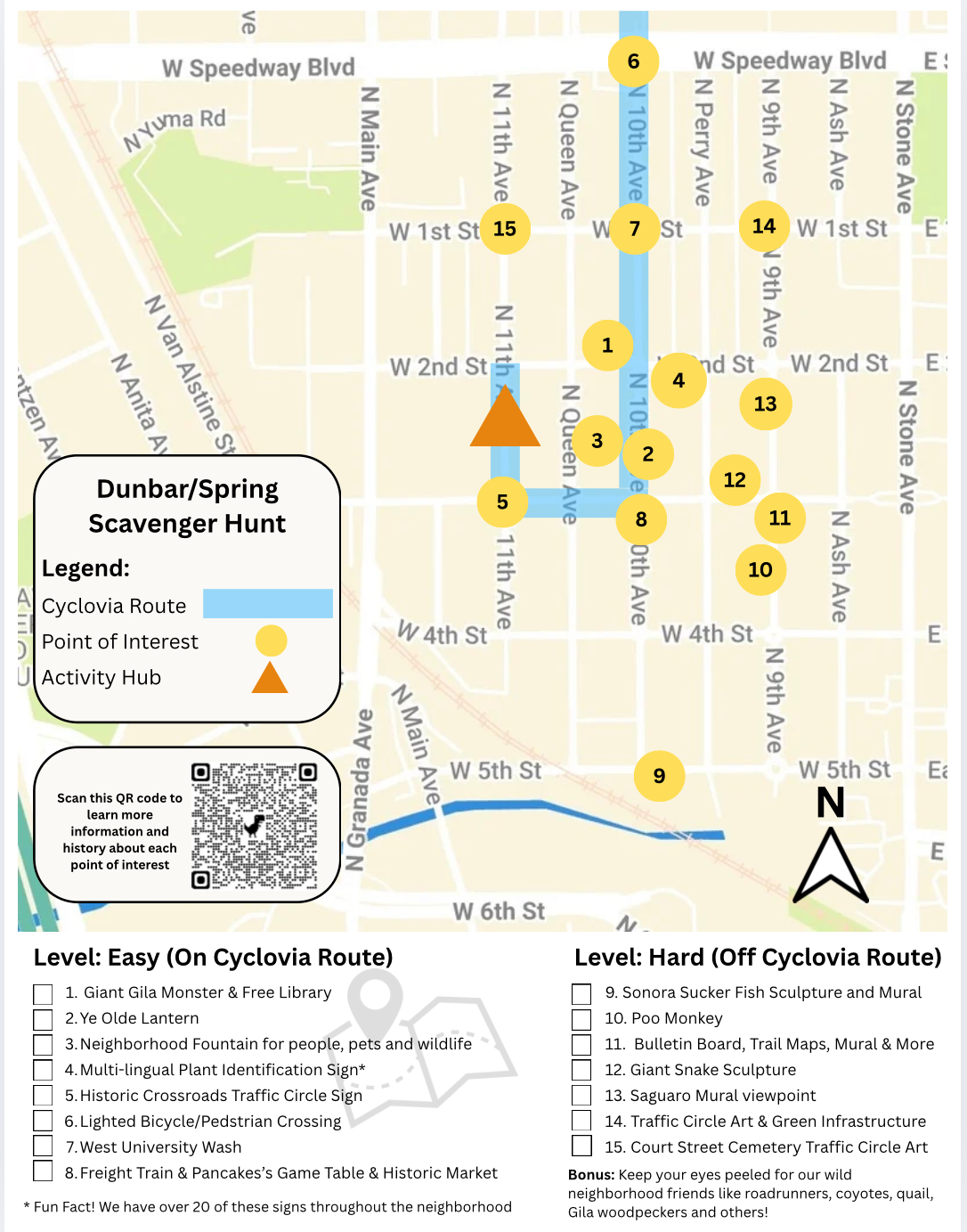
Scroll down for addresses, descriptions, history, and stories for each numbered site (plus bonuses)…
1. Giant Gila monster and free library
WHERE: northwest corner of 10th Avenue and 2nd Street
on north side of 2nd Street
The Gila monster (a native lizard) sculpture/bench was made by artists Hiro Tashima and Jason Butler, funded through a year 2010 Pima County Neighborhood Reinvestment grant.
The lizard is reading a poem by African American poet/writer Paul Laurence Dunbar in a book held open by its foot.
Our Dunbar/Spring neighborhood is named after the Dunbar school (named after the poet) built here in 1918 to serve African American students during segregation. “Spring” is from John Spring, Tucson’s first public school teacher. The Dunbar school was renamed John Spring school when it was desegregated in the early 1950s.
The original free library was built by neighbors Bill Moeller, Gavin Troy, Turtle, and Ian Fritz in 2012, and may have been the first in Tucson. The new/current one was built in 2024 by Troy Neiman with donations from neighbors (see inside its door for who donated) after the original was destroyed by fire.
2. Ye Old Lantern restaurant neon sign that’s now part of a property fence
WHERE: NE corner of 10th Avenue and University Blvd
on east side of 10th Ave
Ye Old Lantern steakhouse opened in 1959 at 1800 N. Oracle Road, previously it had been the Green Lantern, a BBQ joint that had opened in 1924.
Dirk Arnold brought the sign to the Dunbar/Spring neighborhood when Ye Old Lantern closed in 2006. Dirk has highlighted and preserved Tucson’s historic signage with his replica refrigerator magnets at EndangeredArchitecture.com
3. Neighbor-built public drinking fountain for people, pets, and wildlife
WHERE: 809 N. 10th Avenue
Look for the stone pedestal, and the little concrete basin at its base to hold water for animals – on the side of the mulched public path paralleling the street. This drinking fountain was built around 1994 by neighbor Lynn Jacobs, a couple of years after buying and renovating the adjoining house with his sons, for anyone needing a drink. Turn the lever on slow and just part way for drinking water. If you turn the level all the way it acts as a cooling water cannon.
4. Multi-lingual plant identification signs
WHERE: 141 W. 2nd Street, look along the earthen public pedestrian path.
Though most are along the public path within a one-block radius of 9th Avenue and University Blvd,
and there are some along the Cyclovia route in front of 236 W. University Blvd and along the sidewalk by the Dunbar Project basketball court on 11th Ave between University Blvd and 2nd Street.
These are made through a collaboration between the University of Arizona Arboretum and the Dunbar Spring Neighborhood Foresters, highlighting how our neighborhood’s rain-irrigated native food forest is a satellite of the university’s arboretum and, if joined by other neighborhods, can be part of a continuous parkway to our national parks and forests starting at our front doors and gates.
Scan the QR code with your smart phone camera, for photos and info on the plants’ flowers, edible and medicinal parts, how to plant and harvest, and much more.
For more info see:
5. Neighborhood history crossroads sign
WHERE: traffic circle at 11th Avenue and University Blvd
The crossroads sign was created by local artists Troy Neiman and Zach Lihatsh, and features some of our neighborhood’s historical characters from the past to the present.The art and the water-harvesting traffic circle were funded by a year 2010 Pima County Neighborhood Reinvestment grant.
See HERE for more information on the people and places featured on the sign
6. Lighted bicycle/pedestrian crossing & how we got it (and your hood could too)
WHERE: 10th Avenue and Speedway
Tired of continually having to respond to proposed road widenings, increased traffic, and speed limits on the roads surrounding our neighborhood (and separating us from surrounding neighborhoods), neighborhood activists along with others from surrounding neighborhoods. led by Brad Lancaster and collaborating with planner/consultant Irene Ogata of Planners Ink, organized the Building Bridges Project in 2006 to identify barriers to human-powered transportation/connections between Dunbar/Spring and its surrounding neighborhoods, and how those barriers could be more safely crossed or “bridged”. The final plan was then presented to Mayor and Council, so the city would need to respond to what the neighborhood wanted, rather than the neighborhood having to react to what the city was proposing.
About 10 years later, we got the lighted crossing along with one at Stone Ave and University Blvd, and later another at Main Ave and University Blvd
7. West University Wash & kayaking route in big storms
WHERE: 1st Street from University of Arizona to Estevan Park
1st Street used to be a natural waterway originating on the University of Arizona campus. It was artificially straightened and paved over as the West University and Dunbar/Spring neighborhoods were built out, but it still flows up to a knee-high depth in big storm events.
Water-harvesting traffic-calming round-a-bouts and chicanes/curb extensions along with some street-side rain gardens take advantage of this abundant flow to free irrigate associated native plantings (though there is plenty of surplus stormwater to do much more).
The water-harvesting traffic-calming along 1st Street was funded by a year 2010 $500,000 Pima County Neighborhood Reinvestment grant for which the neighborhood decided to spend the money on water-harvesting, native tree planting, traffic-calming, and public art – all within the neighborhood’s public commons.
For a map of the West University Wash’s watershed or “waterhood” see the map on the community bulletin board on the SE corner of 9th Avenue and University Blvd.
8. Freight Train and Pancake’s game table and historic Lim Poy Co market
WHERE: SE corner of 10th Avenue and University Blvd
Two neighborhood characters, one named Freight Train and the other named Pancake, used to hang out at a table and chairs alongside the Lim Poy Co market (on the NE corner of 10th Ave and University Blvd) playing dominos, chess, and checkers. They were community sentinels and greeters saying hello and talking to passers by. They left when the market closed but this art installation is a memorial to them and that time, and an invitation for you to sit for a game and friendly conversation in the public right-of-way.
The installation was funded by a Pima County Neighborhood Reinvestment grant in 2010 and made by artists Hiro Tashima and Jason Butler.
Lim Poy/Lim Nuey Market
198 W. University Blvd
According to Dunbar: the Neighborhood, the School, and the People by Aloma J. Barnes, “In 1940 the Dunbar neighborhood had five markets/stores run by Chinese families: Lim Poy/Lim Nuey at 198 W. 3rd St (University Blvd), Sunnyside Grocery at 740 N. 12th Ave (Main Ave), Don Sen Lee at 628 N. 12th Ave (Main Ave), Don Wah’s/Dolly’s at 902 N. 12th Ave (Main Ave), and Paul’s/Jim’s at 647 N. 9th Ave.” Though there were still more prior to 1940.
The markets were all within walking distance for neighborhood residents, and also acted somewhat like credit unions, essential during the depression. One could get goods (as little as one slice of bread and a single slice of bologna) on credit, the transaction recorded in a notebook beside the cash register, and you’d pay it back when you had the money.
The Lim family lived in the back of their market (as was the case with many of the family-owned markets), though after business hours customers would sometimes knock on their window to ask them to open up so they could buy something. The building is no longer a market, but a residence. Our neighborhood’s last historic corner market, Jim’s Market, closed around 1992.
9. Sonora sucker fish & rainwater-harvesting horned lizard sculpture and adjoining mural
WHERE: SE corner of 10th Avenue and 5th Street
Bilingual education signage on the bollard (look on both east and west side of chicane) within the water-harvesting traffic-calming chicane/curb extension tells the story of this beautiful sculpture and what it informs and inspires.
10. Poo monkey
WHERE: 727 N. 9th Avenue. Look inside the gate.
The Magic Carpet Miniature Golf course near Speedway and Wilmont in Tucson was open from 1970 to 2008. Now demolished (a Chuck E Cheese now sits where the course used to be) many of their whimsical installations were saved including the “Poo Monkey” whose tail was atop a putting hole. You’d swing the tail, then take a putt, trying to get the ball in the hole before the tail swept your ball away.
11. Community Bulletin Board, Bilingual Neighborhood Forest trailhead maps, educational signage, mural, and how we got (and you could get) bicycle boulevards and green infrastructure
WHERE: SE corner of 9th Avenue and University Blvd
The rain-irrigated trees:
The native trees planted here were planted in 1996 as part of our neighborhood’s first annual rain and native food forest planting (this next year will be our 30th!). The trees were just a 5-gallon-size when planted. They are watered solely by the roof runoff passively harvested from the adjoining automotive parts store/warehouse.
See this video for how this works.
The community bulletin board:
Neighborhood volunteers including Bill Moeller, Ian Fritz, Gavin Troy, and City High School students and staff built and painted the community bulletin board where our two neighborhood bicycle boulevards intersect.
Allen Reilley later raised and reinforced its roof to make for easier pedestrian access.
Trailhead maps and signage:
Bilingual educational signage, including our neighborhood forest’s trail maps, installed by Pima Association of Governments (PAG) and the Dunbar Spring Neighborhood Foresters.
Mural:
Painted by neighborhood artist Sue Johnson and volunteers it features a day in the life of the neighborhood, the All Souls Procession (Sue helped start in Tucson), and a dream she had.
How we got our bicycle boulevards & green infrastructure rain gardens and traffic calming (and how your neighborhood could too):
In the mid 1990s our neighborhood started pushing the city to help us slow down speeding cut-through traffic in our neighborhood, and to improve bicycle and pedestrian infrastructure, but the city was initially not very responsive.
So, the neighborhood took action on its own.
Our Neighborhood Foresters annual rain and native tree planting program began in 1996 whereby we worked with neighbors to plant street-side native food trees within water-harvesting basins (we planted over 200 trees that first year, and have since planted over 1,800!). As the trees grew, they made our wide streets feel narrower, and encouraged more neighbors to walk and bicycle thanks to the growing shade.
The water-harvesting basins and their trees also became barriers to cars illegally parking on the public walkways, thus more people began to park on the street, and the cars parked on the street helped narrow the streets, which helped slow traffic.
In the year 2000, the Entrada Real apartments were built at Stone Avenue and University Blvd, and they wanted to take over the section of public street (Ash Avenue) which was between their apartments and their parking lot. So, the neighborhood association worked with the city and Ward 1 office to ensure the developer of the apartments would contribute to the neighborhood (in the form of funding two traffic circles, a property wall screening existing homes from the parking lot, and a $20,000 donation to the Dunbar Project) in exchange for the section of Ash Avenue.
In 2005, those two traffic circles on 9th Avenue at University Blvd and 2nd Street were built as the neighborhood’s first. They were also a first in that the plantable space inside the circles’ curb was depressed lower than the street to harvest rainwater, it was planted with native food-bearing plants and stewarded by adjoining neighbors, and the design & construction of the circles was half the cost of the city’s typical design (thanks to designer Henry Jacobson having the asphalt cut exactly where the curb was to go, then using the remaining asphalt as half the form work for the concrete curb – usually the city would have the asphalt over cut to make room for more concrete curb formwork, which then creates the need and cost of replacing the excess asphalt removed).
In 2006, the neighborhood’s Building Bridges Project identified key connections between our neighborhood and its surrounding neighborhoods that had to be made safer for pedestrians and cyclists. This eventually led to lighted bicycle pedestrian crossings at Stone and University Blvd, Speedway and 10th Ave, and Main Ave and University Blvd.
In 2010 the neighborhood received a $500,000 Pima County Neighborhood Reinvestment grant, and decided to spend the money on traffic-calming, water-harvesting, native tree planting, and public art. This resulted in the neighborhood having in the year 2010 a total of…
- 10 water-harvesting traffic circles,
- 33 water-harvesting/traffic-calming chicanes
- Over 85 street-side basins fed by 50 curb cuts and 35 curb cores
- 7 speed humps
All of which further helped slow traffic, while enhancing the walking and bicycling environment in the neighborhood.
Due to these efforts the city recognized how much bicycle and pedestrian traffic had increased on and along our neighborhood streets, as car traffic had lessened and slowed down. This resulted in the city reclassifying University Blvd, 10th Avenue north of University Blvd, and 9th Avenue south of University Blvd as bicycle boulevards.
Building on those efforts the Dunbar/Spring Neighborhood Foresters designed and built four more water-harvesting traffic-calming chicanes at University Blvd and 9th Avenue with Inflation Reduction Act grant funds in 2025, and got three more speed humps, along or approaching the bicycle boulevards, through the city’s speed hump program.
In 2025, the city’s bicycle boulevard program also installed bicycle boulevard signage, three additional speed humps, and two additional water-harvesting traffic-calming chicanes along our neighborhood’s bicycle boulevards.
There is hopefully more to come, the Dunbar/Spring Neighborhood Foresters have been working with neighbors to pass around petitions to get approval for four more water-harvesting traffic-calming round-a-bouts, 13 more water-harvesting traffic-calming chicanes/curb extensions, and six more speed humps.
We will be posting how-to guides for other neighborhoods on how to create such green infrastructure at NeighborhoodForesters.org by the end of the year.
For how we organize our annual rain and native food forest plantings see here.
12. Giant snake sculpture
WHERE: 128 W. University Blvd
The Magic Carpet Miniature Golf course near Speedway and Wilmont in Tucson was open from 1970 to 2008. Now demolished, many of their whimsical installations were saved including the giant snake & palm tree currently being renovated.
I remember the snake being the last hole of the miniature golf course, and if you putted the ball up a ramp and into the snake’s mouth, and if it would then go through a metal ring and down the snake’s throat a bell would ring, and you’d win a free round at the course.
But you couldn’t cheat and toss the ball into the snake’s mouth because there was an attendant watching and filming your every move with a camera.
Dunbar/Spring resident and metalworker Moises Orozco did the restoration work on the sculpture, painting it in the style of an Arizona mountain kingsnake (Lampropeltis pyromelana).
At night its eyes and mouth light up red if you get close.
13. Saguaro mural viewpoint
WHERE: From 9th Avenue (ideally south of University Blvd), look south toward downtown to see the mural on the Transamerica building downtown.
The mural was painted by Joe Pagac in 2025.
14. Traffic circle art and green infrastructure
WHERE: intersection of 9th Avenue and 1st Street
The signs around the traffic circle capture scenes the artist Mary Luckling observed our the neighborhood in 2010.
The art and the water-harvesting traffic-calming roundabout and area chicanes/curb extensions was funded by a Pima County Neighborhood Reinvestment grant.
15. Court cemetery traffic circle art
WHERE: traffic circle at 11th Avenue and 1st Street
The Court Street Cemetery took up the whole area between 2nd Street and Speedway Blvd and Stone Avenue and Main Avenue.
It was in use from 1875 to 1909 holding an estimated 8,000 to 9,000 burials.
Many of the remains were not relocated when houses were built on the old cemetery grounds, so it is not uncommon for neighbors to dig up a burial when digging a foundation, a sewer trench, or digging a tree hole.
Neighbor Moses Thompson accidently discovered three burials on his property which is at one of the old entrances to the cemetery, and where archaeologists estimate he has at least 90 more on his site. Moses started sensing ghosts after the discovery until Josefina at the Saint Mary’s floral shop pointed out that he had nothing to worry about as this was one of the most blessed places in Tucson thanks to all the prayers and blessings of those who visited and said good bye to their departed loved ones.
Listen to Moses Thompson’s 2016 engrossing live storytelling about this at this link:
https://odysseystorytelling.libsyn.com/moses-thompson-natural
Public art by Mary Luckling funded by a year 2010 Pima County Neighborhood Reinvestment grant Street is a memorial to the cemetery.
16. Tucson Arroyo
WHERE: You can see it from either side of the bridge on N. Main Avenue between 5th Street and 6th Street. But it continues upstream and underground to the east as it was buried in a concrete culvert on the north side of the Downtown Links roadway project.
Before the Tucson Arroyo was largely buried, it was an essential wildlife corridor, as javalina, coyotes, and other native wildlife would use the arroyo as a pathway connecting neighborhoods. There used to be an earthen ramp at the south end of 10th Ave, south of the railroad tracks that enabled wildlife to enter and exit our neighborhood via the arroyo. The Downtown Links roadway project eliminated that access.
But we can push the City of Tucson to create a new wildlife access ramp.
And perhaps more of the arroyo could once again be daylighted, meaning it could be unburied and made visible again. That way its water flow could freely grow more cooling native plant shade, wildlife habitat, stormwater management, and beauty; while more of its flow could also infiltrate the soil and recharge our aquifer (currently the concrete culvert does not allow for this).
17. Che Guevara Park, a potential future native Spadefoot toad and firefly park
WHERE: Southwest corner of the intersection of 10th Avenue and 5th Street.
In the 1990s neighbor Bill Moeller planted some South American mesquite trees in what was then a vacant triangular lot with a major natural gas line running beneath it, and he named the newly planted space Che Guevara Park.
There also used to be a large ephemeral puddle/pond at the south end of 10th Avenue that would fill with stormwater in the monsoon storms, and was a big spadefoot toad breeding ground where you could hear the toads serenading each other with their singing of their love song. Mosquitoes were not an issue in the puddle/pond, because the spadefoot toads and their tadpoles would eat any mosquito larvae that appeared.
We could renovate Che Guevara Park to be a water-harvesting, flood-controlling, spadefoot toad and firefly park of native plants freely irrigated by stormwater harvested off 5th Street by lowering the park area to just beneath the elevation of 5th Street (a large amount of stormwater flows down 10th Avenue and pools on 5th Street before entering a stormdrain on the south side of the street.
We can plant native trees and understory plants that support much more native wildlife and are hardier than the South-American mesquite, and which would eventually take the place of the non-native mesquites that are prone to blow over and broken branches in storms. This would also support native fireflies/lightning bugs which used to be in our neighborhood – we can bring them back by reestablishing their habitat.
Educational signage would inform the public of the project, and volunteer stewards would help steward the park along with the City of Tucson’s Storm2Shade program and Pima County Flood Control.
For more neighborhood history and information see:
• Dunbar: The Neighborhood, the School, and the People 1940-1965 by Aloma J. Barnes
• Pursuing the American Dream: Tucson Chinese-Owned Grocery Stores by Dr. Howard J. Eng
• www.DunbarSpringNeighborhoodForesters.org
• Historical buildings in Dunbar/Spring
• DunbarSpringNeighborhoodForesters.org
BONUS SITES:
B1. Largest & oldest ironwood tree in neighborhood (grown from a 1-gallon-size pot)
WHERE: 124 W. University Blvd
Neighbor Elizabeth Upham planted this Desert Ironwood tree in 1981 or 1982 when it was just a seedling in a one-gallon-size pot.
It has edible white and purple flowers and edible seed that can be processed and eaten like edamame when green or roasted and eaten like peanuts when brown and mature). It is also one of the keystone species of the Sonoran Desert, and supports a diverse array of wildlife and understory species.
Few plant nurseries sold such native plants back then, and few people planted them, but that is changing thanks to those who did, and do…
Such native trees are offered in our Neighborhood Forester’s annual rain and native food forest plantings (we plant Tucson Basin native plants), which we started in 1996. This will be our 30th year, and this tree convinced the city that it was possible to grow desert ironwood trees in the city (officials from Trees for Tucson in the 1990s had thought it would be too cold for desert ironwood trees in the Tucson Basin, but they thrive!
B2. Street-side rain gardens
WHERE: Look for curb cuts and curb cores allowing street runoff to enter street-side basins along our neighborhood streets.
– For more recent installations from our Neighborhood Foresters’ annual rain and native food plantings along the Cyclovia route see north side of 745 N. 10th Ave, 232 W. University Blvd, 236 W. University Blvd
– The NW corner of 9th Ave and University Blvd adjoining the 813 N. 9th Avenue property for the first pre-legal, and later legalized curb cuts and street-side rain gardens in neighborhood (which helped legalize the practice city-wide). Bilingual educational signage at this site tells the story.
These street-runoff-harvesting street-side rain gardens provide free irrigation water for life for the associated native food- and medicinal bearing vegetation!
See here for more on our neighborhood’s rain-irrigated native food forest efforts.
The street-side rain gardens also help control flooding. The goal is for these installations to give more water back to our local hydrology and ecology than they take. Once the associated native plantings are established (1 to 3 years after planting) they are only watered by rainfall and the passively harvested street runoff—NO imported municipal or well water is used. And the harvested rainwater also helps recharge our groundwater. If enough of us do this we can sustainably increase our groundwater reserves and help increase and bring back the natural flow of springs, creeks, and rivers.
For how you can do the same or better see:
NeighborhoodForesters.org
HarvestingRainwater.com
B3. Front porches
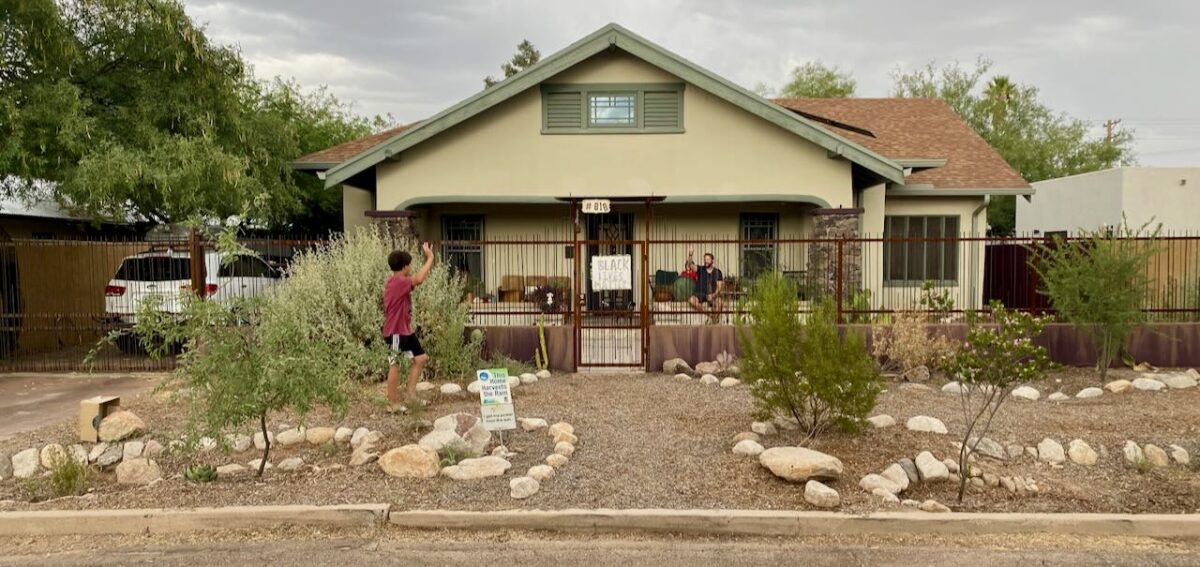
WHERE: how many houses can you spot with a front porch?
Neighborhood elder Gail Shaw told Brad Lancaster that when she was a child in Dunbar you always had “aunties” and other friendly neighbor eyes watching you from front porches and windows when you ventured out into the neighborhood keeping you safe or reprimanding you if you did bad.
Thus, it bothered her every time she saw a new resident or owner put up a solid wall or fence that blocked the view of friendly eyes, and she was overjoyed anytime someone took down a wall or made it a see-through fence for she felt that walls made strangers, while sight connection built a stronger community.
B4. Two front doors
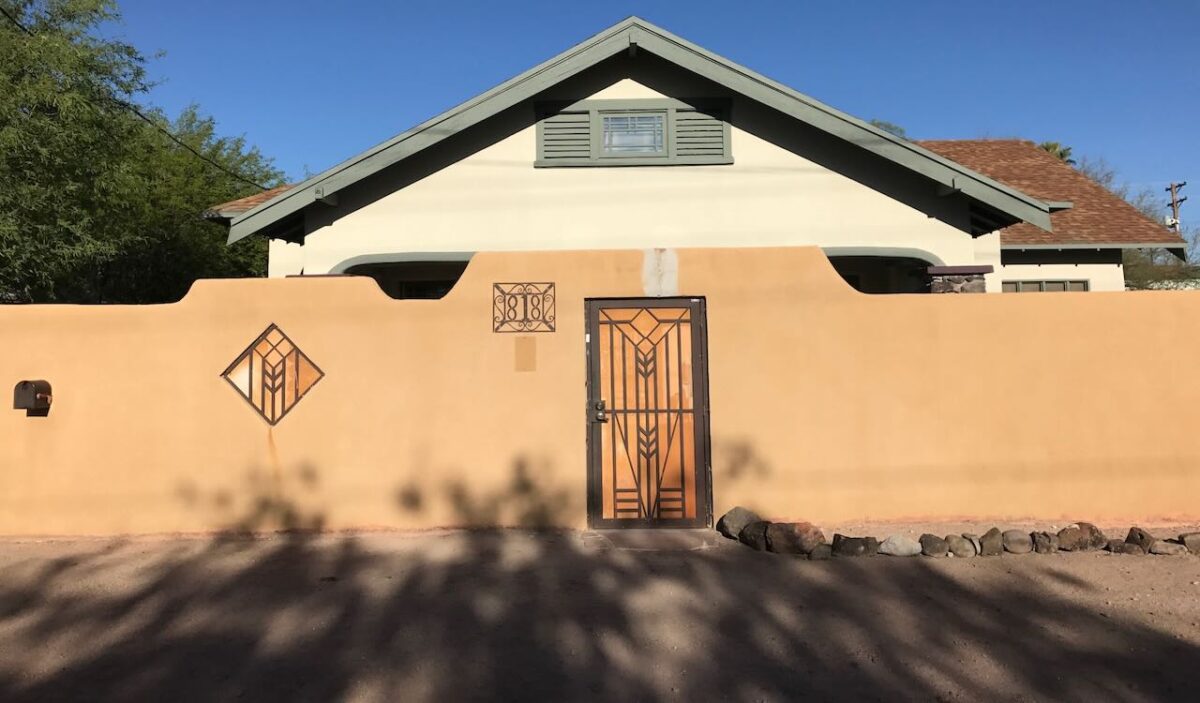
WHERE: How many houses can you spot with two front doors?
828 N. 9th Ave is a starter
A number of our neighborhood’s historic houses have or had two front doors.
It was common for families to rent a room to a border, and the second front door would often be to the room that was rented or to a business the family ran from the house.
The demand was likely high in Dunbar/Spring during the years of segregation as this neighborhood was never redlined, meaning anyone could get a loan to purchase property, and live, work, pray, study, or play here regardless of their ethnicity or religious beliefs; whereas this was not the case in many other Tucson neighborhoods.
B5. Azteca shoe shop
WHERE: 821 N. 9th Avenue.
Now a vacant lot, the bilingual sign on the gate has photos of the shop and tells the story of this once lively neighborhood business, the neighborhood, and its people.
B6. The Dunbar School
WHERE: SW corner of 11th Avenue and 2nd Street
Built in 1918 to serve African-American students in the years of segregation, and named after the African-American poet Paul Lawrence Dunbar.
Desegrated in 1950s, expanded with the two-story brick addition, and name changed to John Spring, named after the first the first public educator in Tucson in 1872.
School closed in the early 1970s.
The city of Tucson attempted to turn the closed school into a jail for DUI offenders, but the neighborhood successfully fought this.
In 1994 the property was purchased for $25 by a partnership of the Tucson Urban League, the Juneteenth Festival Committee, the Alumni of the school, and the Dunbar/Spring neighborhood association to turn the school and property into an African-American Cultural Center and Community Center.
The Dunbar/Spring neighborhood is named after the two eras and names of the school.
For more info see:
• Dunbar: The Neighborhood, the School, and the People 1940-1965 by Aloma J. Barnes
• DunbarTucson.com