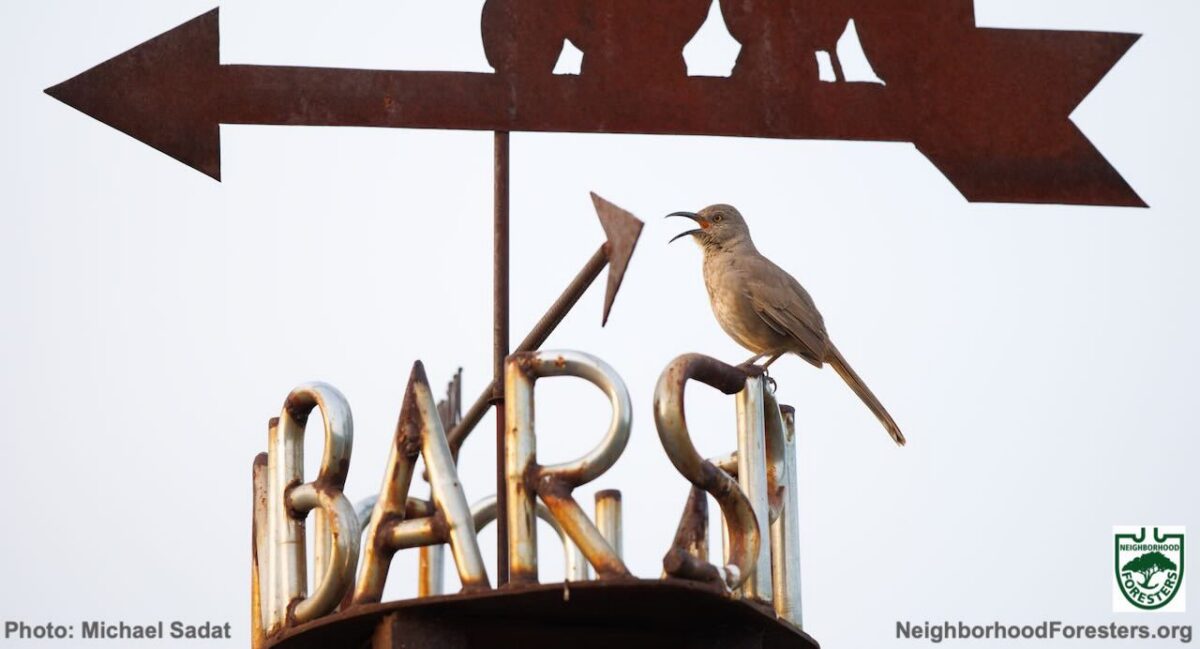
Local birder Michael Sadat has been doing bird surveys in the public rights-of-ways of our neighborhood forest lately about every two weeks or so, so we can better document bird life and the effectiveness of our over 30-year effort to plant native plants and habitat in the public commons of our neighborhood (and neighbors’ individual efforts to plant such native habitat in their yards).
Below are links to checklists of birds he surveyed on various dates, along with photos and recordings he took.
(He usually surveys for 3 hours in the early morning daylight hours. Perhaps you’ve seen him. Michael is tall and fit with short black hair, black mustache, beard, carrying a camera with a large telephoto lens).
In just 5 visits to the neighborhood Michael has already observed 42 bird species & expects to document many more.
Links to birding checklists, photos, and recordings:
Keep checking back, as I’ll post links to new checklists as Michael provides them.
Bird listings on eBird for Dunbar/Spring neighborhood since 1996
On 3-30-2026, Michael researched all bird listings on eBird since 1996 (the first year of our Dunbar/Spring Neighborhood Foresters annual rain & native food forest plantings).
For a breakdown of bird species reported to eBird since 1996 in Dunbar Spring see this link (though it can take a while to load):
From Michael:
“I’m hesitant to consider these data due to heavy observation bias. It solely depends on birders being present & reporting to eBird, a database that has become exponentially popular in recent years, but wasn’t around long before then. Birders can submit historical reports to eBird of birds they saw in the 90s & 00s, but they typically don’t do that. Note the absence of reports from 1999-2008 & very low numbers in certain years, which is more indicative of how many birders were present rather than birds. There simply haven’t been enough reports to show that Dunbar Spring has become more bird-diverse since 1996. One can only speculate that it has because of habitat restoration.
Regardless, I’ll make it a point to survey birds in your yard & whoever else you know in the neighborhood that is comfortable with me lurking around. Looking forward to continuing this project!
-Michael Sadat
There have been 75 bird species reported since 1996:
| Species | birds | |
| Rock Pigeon | 3302 | |
| House Sparrow | 1021 | |
| House Finch | 476 | |
| Mourning Dove | 295 | |
| White-winged Dove | 172 | |
| Lesser Goldfinch | 149 | |
| European Starling | 119 | |
| Gila Woodpecker | 82 | |
| Verdin | 74 | |
| Vermilion Flycatcher | 56 | |
| Great-tailed Grackle | 52 | |
| Yellow-rumped Warbler | 52 | |
| Anna’s Hummingbird | 37 | |
| Northern Mockingbird | 35 | |
| Curve-billed Thrasher | 29 | |
| Cedar Waxwing | 26 | |
| Eurasian Collared-Dove | 24 | |
| Cooper’s Hawk | 19 | |
| Lucy’s Warbler | 17 | |
| Abert’s Towhee | 15 | |
| Broad-billed Hummingbird | 14 | |
| Red-tailed Hawk | 12 | |
| Cactus Wren | 10 | |
| Costa’s Hummingbird | 10 | |
| American Kestrel | 9 | |
| Brown-crested Flycatcher | 9 | |
| Gambel’s Quail | 9 | |
| Western Bluebird | 9 | |
| Common Raven | 8 | |
| Black-chinned Hummingbird | 7 | |
| Ladder-backed Woodpecker | 7 | |
| Lark Sparrow | 7 | |
| Phainopepla | 7 | |
| Ruby-crowned Kinglet | 7 | |
| Inca Dove | 6 | |
| Northern Flicker | 6 | |
| Western Kingbird | 6 | |
| Peregrine Falcon | 5 | |
| Say’s Phoebe | 5 | |
| Sharp-shinned Hawk | 5 | |
| White-crowned Sparrow | 5 | |
| American Robin | 4 | |
| Black-tailed Gnatcatcher | 4 | |
| Harris’s Hawk | 4 | |
| Pyrrhuloxia | 4 | |
| Turkey Vulture | 4 | |
| Bell’s Vireo | 3 | |
| Black-throated Sparrow | 3 | |
| Brewer’s Blackbird | 3 | |
| Greater Roadrunner | 3 | |
| Loggerhead Shrike | 3 | |
| Northern House Wren | 3 | |
| Northern Rough-winged Swallow | 3 | |
| Ring-necked Duck | 3 | |
| Rufous-winged Sparrow | 3 | |
| Ash-throated Flycatcher | 2 | |
| Great Horned Owl | 2 | |
| Hooded Oriole | 2 | |
| Northern Cardinal | 2 | |
| Zone-tailed Hawk | 2 | |
| Bewick’s Wren | 1 | |
| Black-chinned Sparrow | 1 | |
| Black-throated Gray Warbler | 1 | |
| Bridled Titmouse | 1 | |
| Cassin’s Vireo | 1 | |
| Green-tailed Towhee | 1 | |
| Lark Bunting | 1 | |
| MacGillivray’s Warbler | 1 | |
| Prairie Falcon | 1 | |
| Purple Martin | 1 | |
| Song Sparrow | 1 | |
| Swainson’s Hawk | 1 | |
| Western Warbling Vireo | 1 | |
| White-throated Thrush | 1 | |
| Wilson’s Warbler | 1 | |
I think the species count of 75 can be considered a minimum, but the numbers of individual birds are unreliable — only 9 Gambel’s Quail in 30 years? Another example of observation bias!”
Though we do have heavy predation of birds by cats in our neighborhood.
Some things that would help our neighborhood’s quail (and other native birds) population include:
• Spading and neutering neighborhood cats (especially the feral ones)
• Keeping cats indoors
• Keeping cats in a catio when outdoors
• Putting bird-alerting collars on outdoor cats
• Put special stickers on windows to deter birds from flying into window. These are available at the Tucson Bird Alliance Nature Shop at 300 E University Blvd #120, Tucson, AZ 85705.
• Be part of Tucson Bird Alliance’s Habitat at Home program
Are their birds you’ve seen that are not listed?
Since 3-30-2026 Michael has documented more bird species, and perhaps you’ve seen still more.
I’ve observed a nighthawk in early evening and early morning hours in our neighborhood, but it is not yet on the list.
See HERE for bats observed in our neighborhood
Major funding for this project is provided by the Arizona Department of Forestry and Fire Management and USDA Forest Service. These institutions are equal opportunity providers and employers.